Uranus and Neptune's Magnetic Fields Show Unusual Variability
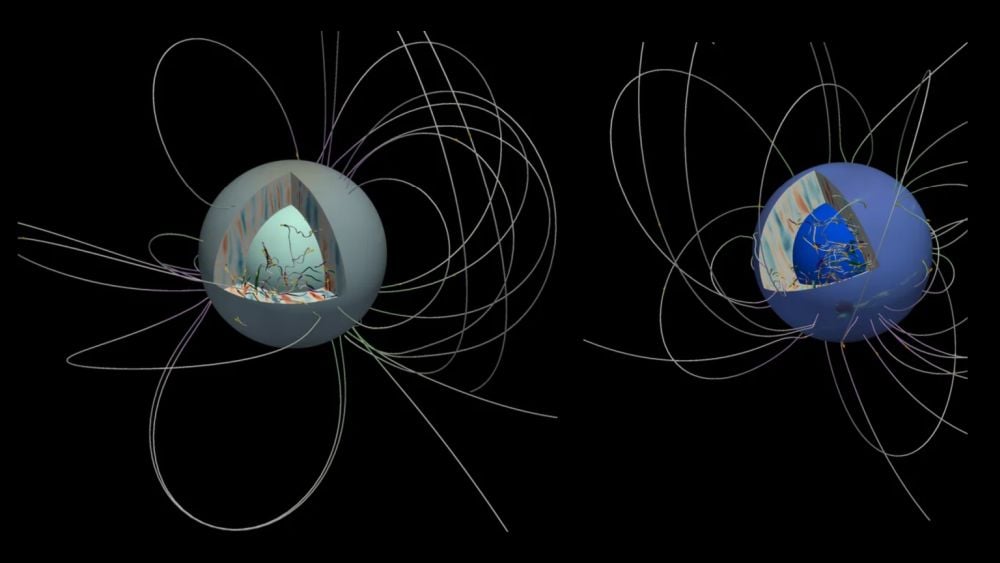
Recent modeling research suggests that the magnetic fields of Uranus and Neptune, the Solar System's ice giants, may change more rapidly than previously understood. These findings highlight the unique and complex nature of their magnetic fields, which differ significantly from Earth's.
Voyager 2, the only spacecraft to have flown by Uranus and Neptune, revealed that both planets have highly tilted and non-dipolar magnetic fields. Uranus's field is tilted approximately 59 degrees off its rotational axis, while Neptune's is tilted about 47 degrees. In contrast, Earth's magnetic field is tilted by about 11 degrees.
A study published in *Nature Communications Physics* utilized dynamical models to simulate the internal dynamos of these planets. The research found that varying electrical conductivity within the dynamo regions could reproduce the observed complex and non-axisymmetric magnetic fields. The models suggest that these fields may exhibit multipolar and time-varying behavior.
Model simulations indicated that the magnetic fields could diverge significantly over decades. For instance, a model representing Uranus-like conditions showed a tilt change of approximately 13 degrees over 40 years, while a Neptune-like model displayed swings up to 84 degrees in the same period.
Despite these findings, the variability remains theoretical, as no direct observational evidence of magnetic field changes exists. The planets have only been sampled once in situ by Voyager 2. However, auroral observations hint at potential variability, with shifts in auroral bands observed on both planets over the years.
Understanding these magnetic fields is crucial, as they can impact interpretations of auroral and atmospheric data. Ongoing monitoring by the James Webb Space Telescope (JWST) could help test these models, but confirmation will require further in-situ measurements or a dedicated mission to the ice giants.