Trinity Researchers Unveil Method to Analyze Weather on Distant Brown Dwarf
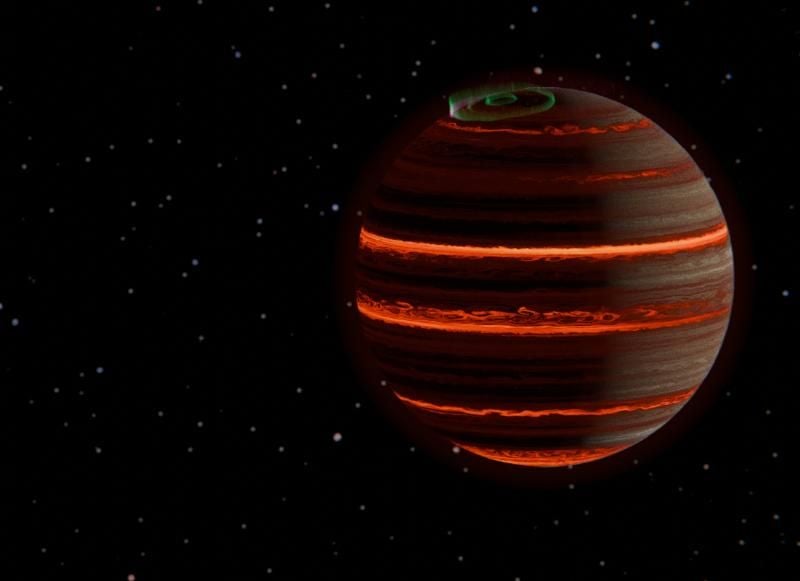
Researchers from Trinity College Dublin have introduced a novel method to study the weather on distant celestial objects, specifically focusing on the brown dwarf SIMP J013656.5+093347, commonly known as SIMP 0136. This technique employs time-resolved spectroscopy data from the James Webb Space Telescope (JWST) combined with Principal Component Analysis (PCA) to decode atmospheric patterns.
SIMP 0136, a young T2.5 brown dwarf with a mass approximately 15 times that of Jupiter, serves as an analog for directly imaged exoplanets. The research reveals that the brown dwarf's weather is primarily governed by two factors: temperature changes and the vertical structure of its clouds.
The study utilized JWST's NIRSpec/PRISM and MIRI/LRS instruments to capture full-rotation time-series spectra. Analysis through PCA distilled the spectroscopic variability into two principal components, which correspond to temperature fluctuations and cloud structure dynamics. These components manifest as three distinct atmospheric states: hotter with thinner clouds, cooler with thinner clouds, and cooler with thicker, vertically extended clouds.
Temperature variations on SIMP 0136 were measured between approximately 1243 K and 1248 K, with a thermal inversion of about 250 K above 10 mbar pressure, suggesting auroral heating. Despite these changes, other atmospheric species remained stable, and silicate clouds displayed patchy coverage without significant longitudinal variation.
This method offers a computationally efficient framework for studying dynamic atmospheres on isolated planetary-mass objects and holds potential for application to other brown dwarfs and exoplanet targets.