Scientists Race to Establish Radio Telescope on Lunar Far Side
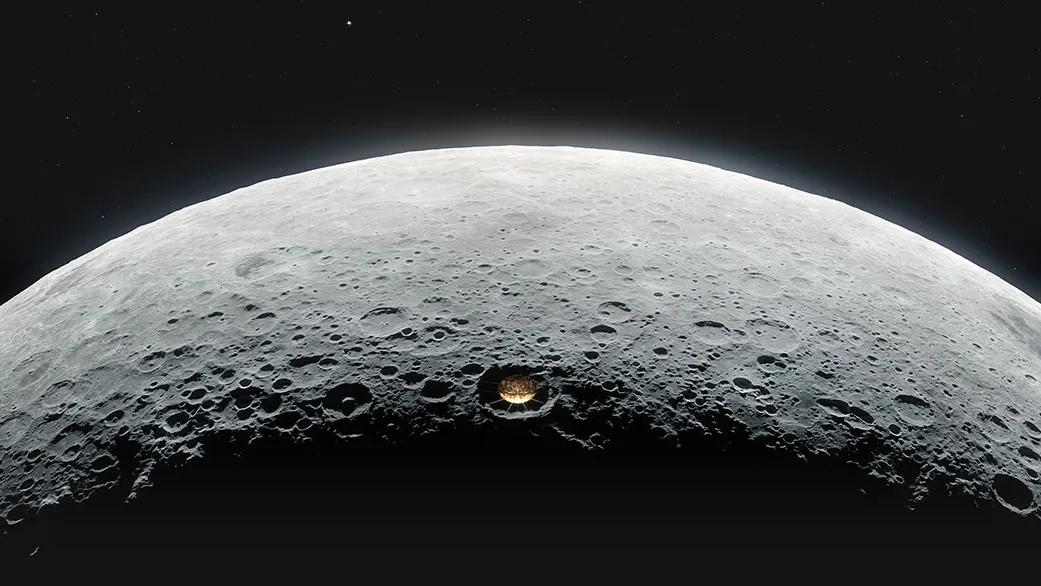
Efforts to construct a radio telescope on the far side of the Moon are gaining momentum, driven by the need to escape Earth's pervasive radio-frequency interference (RFI). The Moon's far side offers a unique environment, shielded from terrestrial transmissions, crucial for detecting faint cosmic signals that are otherwise drowned out by human-made noise.
The concept is supported by a recent paper from lead author David DeBoer of the University of Oxford, emphasizing the urgency of establishing such a facility before the lunar environment becomes compromised by increasing satellite traffic. The Moon's mass and tidal locking provide up to 90 dB of RFI attenuation, creating an invaluable "Radio Quiet Zone" for low-frequency astronomy.
Several projects are underway to capitalize on this opportunity. The LuSEE-Night pathfinder, scheduled for deployment in 2026 via Firefly Aerospace's Blue Ghost lander, aims to study frequency bands between 0.1 and 50 MHz. Meanwhile, NASA's Lunar Crater Radio Telescope (LCRT) concept, awarded $500,000 for further study, envisions robots deploying a mesh dish inside a lunar crater to detect ultra-long-wavelength signals.
Another ambitious project, the FarView Observatory, proposes a massive array of 100,000 dipole antennas over 200 square kilometers, built from lunar regolith to map the early universe. The FARSIDE project also plans to deploy a low-frequency interferometric array to explore the Dark Ages and exoplanet magnetospheres.
These initiatives align with the International Telecommunication Union's regulations, which designate the Moon's far side as a "radio quiet zone" for passive services like radio astronomy. However, a 2026 study warns of the increasing threat posed by lunar satellite deployments, which could erode the RFI-free environment, necessitating additional shielding for future instruments.