New Study Challenges Conventional Views on Antibiotic Resistance
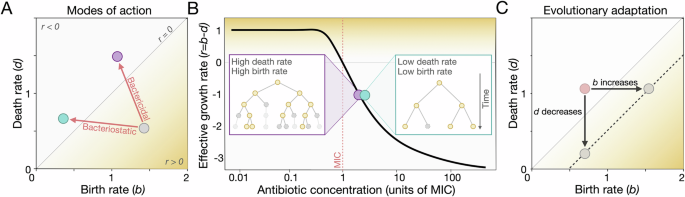
A recent study published in Nature Communications on June 26, 2026, challenges the traditional understanding of antibiotic resistance and tolerance by focusing on the dynamics at the level of individual bacterial cells. The research, conducted by R. Craig MacLean and Rafael Peña-Miller, suggests that the conventional population-level assays, which date back to the 1920s, may not fully capture the complexity of bacterial responses to antibiotics.
The study reveals that the population responses to antibiotics are influenced by the dynamic interplay between individual cell birth and death rates, rather than being solely determined by discrete resistance or tolerance phenotypes. This finding suggests that resistance and tolerance are emergent properties that result from selection pressures on these cellular dynamics.
Key insights from the study include the role of phenotypic heterogeneity within clonal populations, such as variations in efflux pump expression and plasmid copy number, which contribute to differential survival rates under antibiotic exposure. The researchers also highlight that bactericidal antibiotics tend to target actively dividing cells, establishing a positive covariance between high birth and death rates, which constrains the evolution of resistance.
Moreover, the study describes an adaptive walk in evolutionary adaptation, where populations initially increase tolerance through small shifts in birth and death rates before acquiring mutations that enable true resistance. The probability of a resistant cell establishing a lineage, particularly at antibiotic concentrations of just 1/8 of the minimum inhibitory concentration (MIC), is less than 10%, underscoring the role of stochastic extinction in the process.