NASA's Webb Telescope Dismisses Two Dyson Sphere Candidates
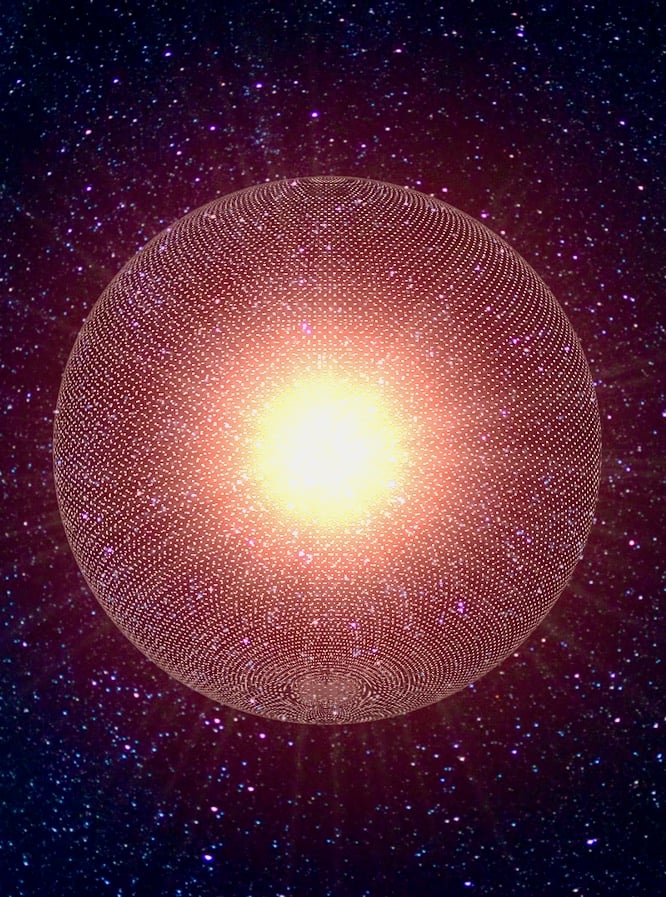
The James Webb Space Telescope (JWST) has ruled out two potential Dyson sphere candidates, known as candidates D and E, as extraterrestrial megastructures. This conclusion was reached by Project Hephaistos, led by Uppsala University, which utilized JWST's advanced imaging and spectroscopy capabilities.
Initial observations by the Wide-field Infrared Survey Explorer (WISE) suggested these M-dwarf stars exhibited infrared excess, a potential indicator of Dyson spheres. However, JWST's detailed observations attributed the excess to background galaxies rather than artificial constructs.
Candidate D's infrared anomaly was caused by a background galaxy at a redshift of approximately 0.9, identified as a Hot Dust-Obscured Galaxy (Hot DOG). Meanwhile, candidate E's anomaly was linked to a dusty starburst galaxy at a redshift of about 0.4, characterized by an extended morphology with bright knots.
Technosignatures, such as waste heat from hypothetical Dyson spheres, are detectable as infrared excesses, making JWST a crucial tool in the search for such signatures. Despite extensive searches, no Dyson sphere candidates have been confirmed, with natural astrophysical phenomena consistently explaining observed anomalies.