Martian Cloud Formation Reveals New Atmospheric Physics
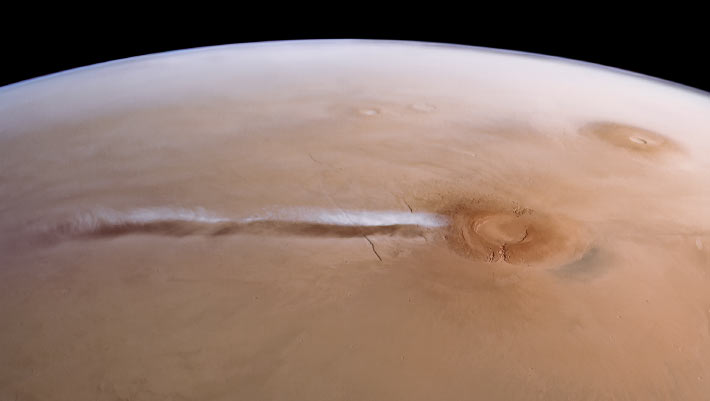
The Arsia Mons Elongated Cloud (AMEC), a striking water-ice cloud on Mars, forms through a newly observed atmospheric process known as homogeneous ice nucleation, according to recent research published in Nature Geoscience. This phenomenon occurs without the need for preexisting particles, challenging established theories of cloud formation.
AMEC appears each Martian spring and summer, developing from the western slope of the 20-kilometer-tall Arsia Mons volcano. The cloud extends up to 1,800 kilometers in length and is less than 200 kilometers wide, forming at altitudes near 45 kilometers above Mars's areoid.
Observations from ESA's Mars Express Visual Monitoring Camera documented the cloud's rapid westward expansion at speeds of approximately 170 meters per second during Martian Year 34. The cloud's formation aligns with the solar longitude range of 220°–320°, peaking around the southern solstice.
Using the Mars Mesoscale Model, researchers identified strong downslope winds and a hydraulic-style jump on the volcano's western slope as initial triggers for the cloud's formation. However, the model initially failed to replicate the cloud's optical thickness and expansion. The breakthrough came with the inclusion of homogeneous nucleation, which successfully reproduced the cloud's characteristics, suggesting this process might be common in Mars's thin, cold atmosphere.
This discovery not only redefines our understanding of Martian meteorology but also opens new avenues for studying atmospheric phenomena on other planets with similar conditions.