Mars's Moons Phobos and Deimos: Key Facts and Future Exploration
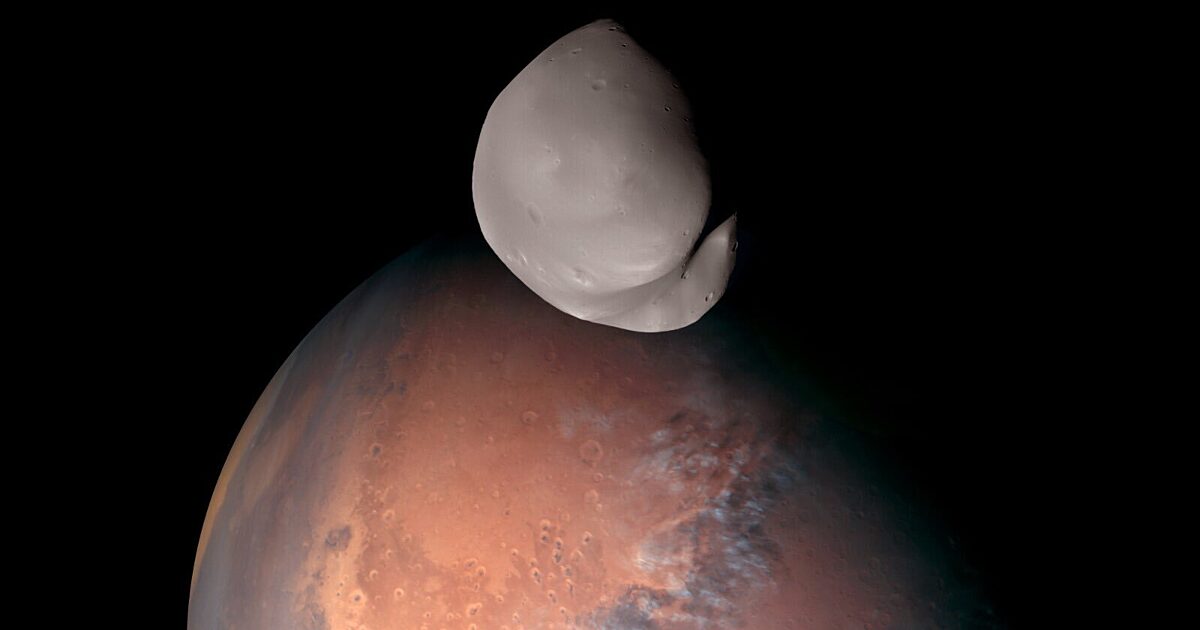
Mars is orbited by two small, rocky moons, Phobos and Deimos, which present intriguing opportunities for scientific exploration. These moons, with their irregular shapes and unique orbital properties, have long been subjects of interest for understanding the history of the Solar System.
Phobos, the larger of the two, measures approximately 26.8×22.4×18.4 kilometers and has a mass of 1.072×10¹⁶ kilograms. It orbits Mars at a distance of about 9,377 kilometers from the planet's center, completing an orbit in roughly 7 hours and 39 minutes. This close proximity makes Phobos the closest known moon to its planet. It is gradually spiraling inward at a rate of about 1.8 meters per century and is expected to either crash into Mars or break apart into a ring within the next 50 million years.
Deimos, in contrast, is smaller, with dimensions of approximately 15×12.2×10.4 kilometers and a mass of 1.48×10¹⁵ kilograms. It orbits Mars at a much greater distance of about 23,460 kilometers, with an orbital period of around 30.3 hours. Deimos's orbit is more stable over long periods compared to Phobos.
Both moons are tidally locked, meaning they always show the same face to Mars. Their surface gravities are extremely low, with Phobos's at about 400 micro-g and Deimos's ranging from 86 to 190 micro-g, depending on location.
The origins of Phobos and Deimos remain a mystery. They may be captured asteroids or remnants from a disk of debris formed by an early impact on Mars. Their near-circular, equatorial orbits challenge the asteroid capture hypothesis and suggest alternative formation theories.
Japan's Martian Moons eXploration (MMX) mission, set to launch in 2026, aims to explore these moons further. The mission will arrive at Mars in 2027, spending a year mapping Phobos and collecting samples before flying by Deimos. The samples are expected to return to Earth by 2031, potentially providing new insights into the moons' origins and the early Solar System.