Mars's Arsia Mons Cloud Challenges Traditional Atmospheric Models
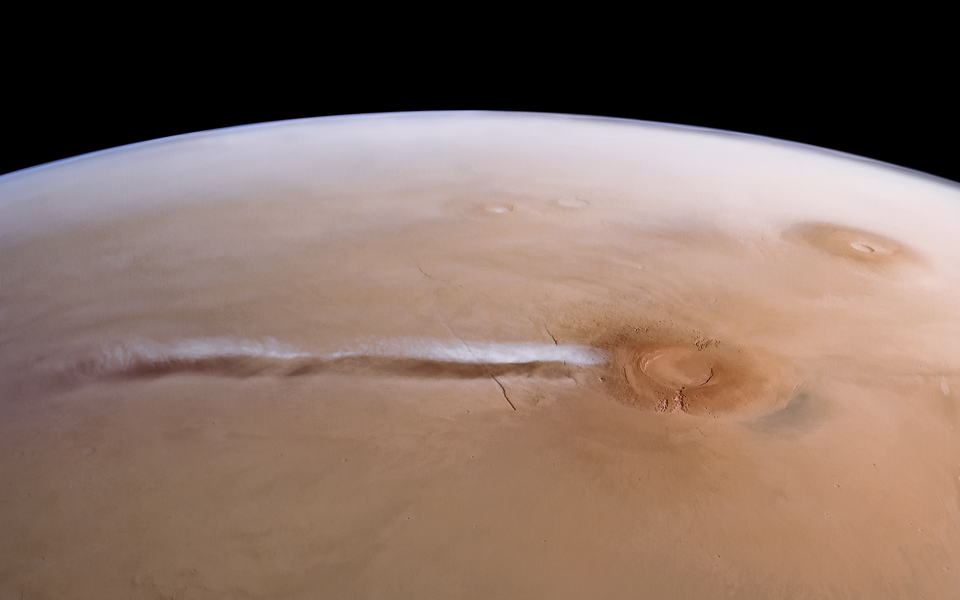
Every Martian summer, a striking meteorological phenomenon occurs near the Arsia Mons volcano: a thin, elongated cloud stretches 1,800 kilometers across the sky. Known as the Arsia Mons Elongated Cloud (AMEC), this formation has puzzled scientists for decades due to its defiance of traditional atmospheric models.
AMEC forms daily during the late southern spring and summer, coinciding with the Martian southern solstice. The cloud appears at dawn, forming a circular head approximately 125 kilometers in diameter before extending into a lengthy tail over the course of a few hours. This rapid expansion occurs at speeds of up to 170 meters per second, reaching altitudes of 40 to 50 kilometers.
Recent research led by Dr. Jorge Hernández-Bernal of the Sorbonne, published in Nature Geoscience, proposes that AMEC could be the first documented instance of homogeneous ice nucleation occurring naturally. This process involves cloud particles forming directly from vapor without the need for dust nuclei, a concept previously only theoretical.
Prior models struggled to account for the full dynamics of AMEC. While mesoscale modeling could replicate the cloud's head formation through gravity-wave-induced cooling, it failed to accurately simulate the tail's expansion and optical depth. The new study's introduction of homogeneous ice nucleation into Mars climate models successfully reproduces AMEC's unique characteristics.
The implications of this discovery are significant, as it challenges existing understanding of cloud physics and may provide insights into atmospheric processes on other planets.