Long-Term Study of Blazar BL Lacertae Defies Classification
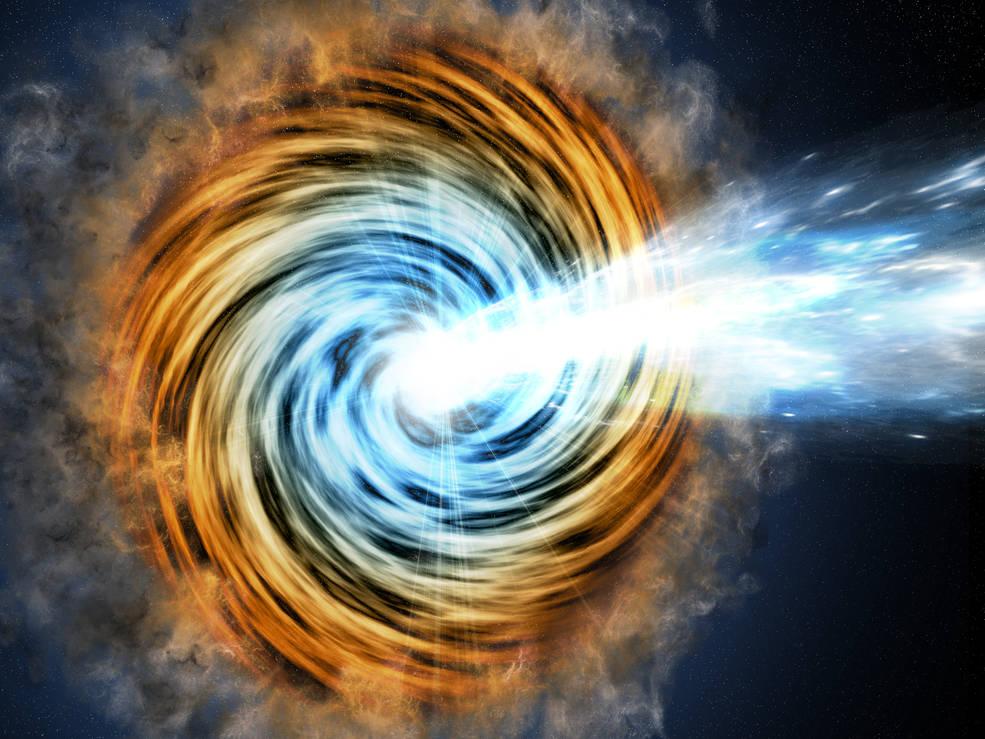
A nearly two-decade-long study of the blazar BL Lacertae by a Polish-German research team has revealed unexpected behavior that challenges traditional blazar classification systems. The findings, published in Astronomy & Astrophysics, show that BL Lacertae, an active galaxy with a jet pointed towards Earth, does not fit neatly into existing categories.
The research, conducted by scientists from the Institute of Nuclear Physics in Kraków and the University of Heidelberg, involved observations from 2005 to 2023 using NASA's Neil Gehrels Swift Observatory and NuSTAR. These instruments provided comprehensive data across the X-ray to ultraviolet spectrum.
The long-term X-ray light curve, covering energies from 0.3 to 10 keV, revealed significant variability in the blazar's spectrum. This variability suggests that BL Lacertae cannot be classified strictly as a BL Lac object or as a flat spectrum radio quasar (FSRQ), categories traditionally used to classify blazars.
BL Lacertae, located approximately 900 million light-years from Earth, was initially mistaken for a variable star before being identified as extragalactic. The study's findings indicate that the blazar's complex behavior escapes current classification schemes, highlighting the need for a revised understanding of such cosmic phenomena.