Lava Worlds Challenge Existing Exoplanet Atmosphere Theories
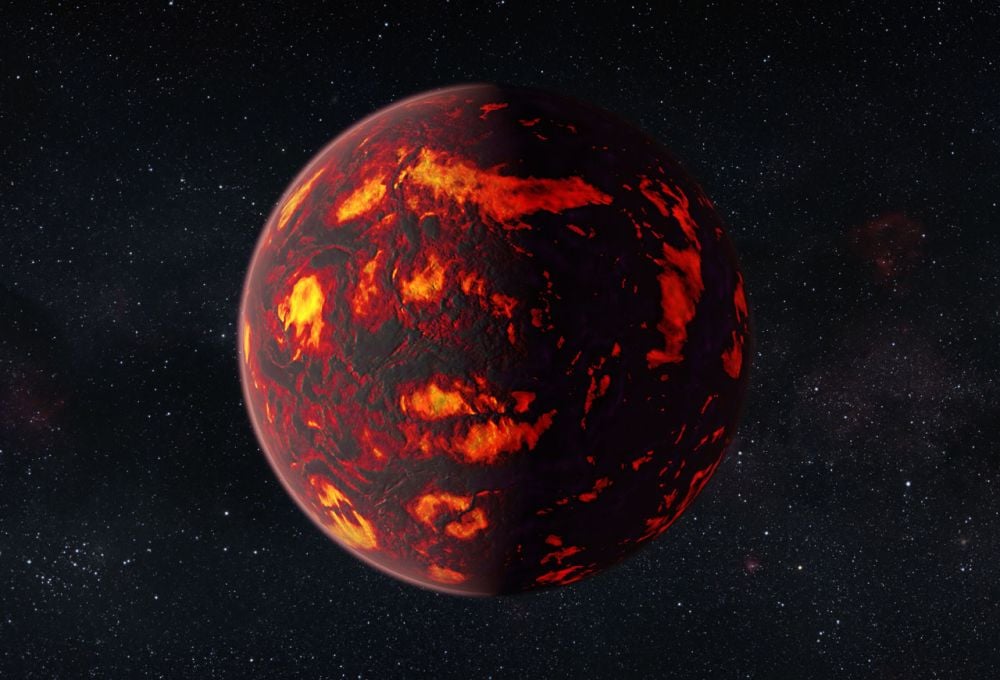
A recent study by Stanford researchers has introduced a new model that challenges existing theories on atmospheric retention in rocky exoplanets, particularly those known as 'lava worlds.' These findings suggest that such planets, despite being in close proximity to their stars, can retain atmospheres, thereby questioning the traditional 'cosmic shoreline' concept.
The study, published on August 24, 2026, in ArXiv, identifies three distinct regimes of atmospheric retention. This includes a 'cosmic sandbar' regime that explains how lava worlds like 55 Cancri e maintain their atmospheres through outgassing from magma oceans, sustained by tidal heating.
Observations from the James Webb Space Telescope have shown that planets such as TOI-561 b and K2-141 b exhibit lower dayside brightness temperatures than expected for airless bodies. This suggests the presence of reflective atmospheres, possibly containing CO₂ or CO, which are inconsistent with the classical cosmic shoreline model.
The study's dual-boundary model reshapes the criteria for identifying exoplanets capable of holding and replenishing atmospheres. It emphasizes the role of interior processes, such as outgassing and tidal heating, in atmospheric evolution, beyond simple escape physics.