Latest Moon Counts for Planets in the Solar System
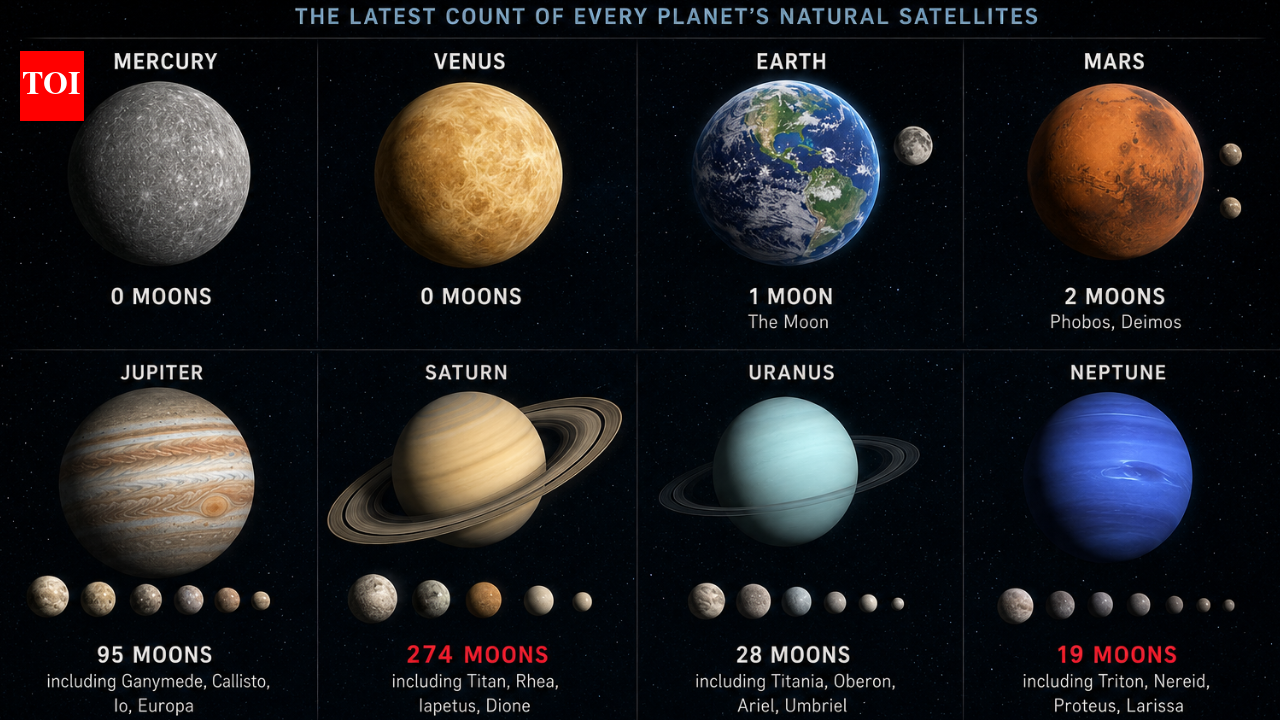
The International Astronomical Union (IAU) has recently updated the official count of moons orbiting the planets in our Solar System, highlighting significant increases for Jupiter and Saturn. As of March 2026, Jupiter has 101 recognized moons, while Saturn leads with 285.
According to NASA, Mercury and Venus remain moonless. Earth has one moon, and Mars hosts two small moons, Phobos and Deimos. Uranus and Neptune have 28 and 16 moons, respectively, with no significant updates reported for these planets.
The IAU's latest announcement confirmed that Jupiter gained four new moons, and Saturn saw an increase of 11 moons over the past year. These updates reflect ongoing discoveries of smaller, often icy satellites around these gas giants.
Overall, the Solar System is home to 439 planetary moons, with an additional 531 small-body satellites orbiting asteroids and dwarf planets, totaling 970 known natural satellites.