JWST Maps First Lopsided Exoplanet Atmosphere
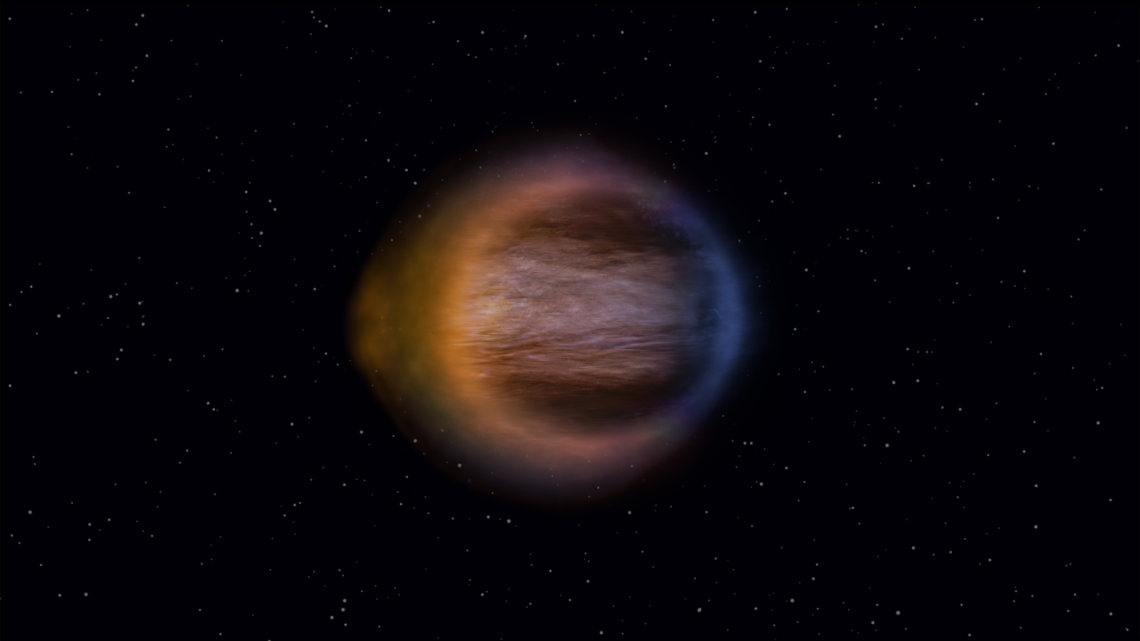
The James Webb Space Telescope (JWST) has provided the first spatially resolved measurement of an exoplanet's atmospheric shape, revealing a distinctly asymmetrical, egg-shaped limb on the hot Jupiter WASP-17b. This exoplanet, located approximately 1,300 light-years from Earth, exhibits a significant temperature contrast between its morning and evening terminators.
Researchers from Cornell University and the University of Bristol utilized JWST data from the TST DREAMS Guaranteed Time Observations program to conduct the study, published in Nature Astronomy on October 14, 2026. The team employed a novel 'transmission strings' method to measure atmospheric thickness at different angles along the planet's limb, challenging the traditional circular assumption.
WASP-17b's evening terminator, transitioning from day to night, shows a significantly more extended atmosphere due to high-speed equatorial jet winds transporting heat from the permanently irradiated dayside. In contrast, the morning terminator remains cooler and more compact. The temperature difference between the terminators is approximately 650 Kelvin, with the evening side's radius being about 1.8 times larger than the morning side.
The study's findings align with theoretical models predicting significant day-night temperature and structural differences on tidally locked hot Jupiters. The research marks a methodological advance in creating a 3D picture of exoplanetary atmospheres using transit-based techniques.