Imperial College Unveils Biodegradable Party Balloon
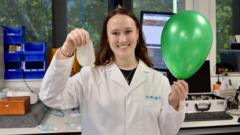
Researchers at Imperial College London have announced the development of Bioloon, a new biodegradable party balloon designed to degrade significantly faster than traditional balloons. This innovation aims to offer an environmentally friendly alternative to standard balloons, which can take years to break down.
The Bioloon is made from a modified latex material that maintains the performance characteristics of conventional balloons, such as multiple inflations and normal usability, but without the harmful additives typically found in vulcanised rubber. According to the research team, this new material could be available on the market by mid-2027.
Juliana Cumming, a PhD student leading the research, expressed enthusiasm about the potential sustainability impact of Bioloon, stating, “We are very excited about the continuous research being carried out which will enable us to improve the sustainability impact of elastomeric materials.”
Professor Jason Hallett, the academic lead on the project, highlighted the environmental challenges identified by an events company that approached them, hoping that Bioloon will encourage a shift towards more sustainable materials in the industry.
Charlotte Melia, co-founder of a party business and partial funder of the research, noted the environmental benefits of Bioloon, saying, “Every celebration leaves something behind … we have created a latex that behaves exactly like the balloon people love, then returns quietly to the earth as biomass.”
Media reports suggest that Bioloon balloons can degrade in approximately nine months, a significant improvement over traditional balloons, though this specific timeframe was not detailed in the initial Imperial College release.