Distant 'Black Hole Star' May Explain James Webb's Little Red Dots
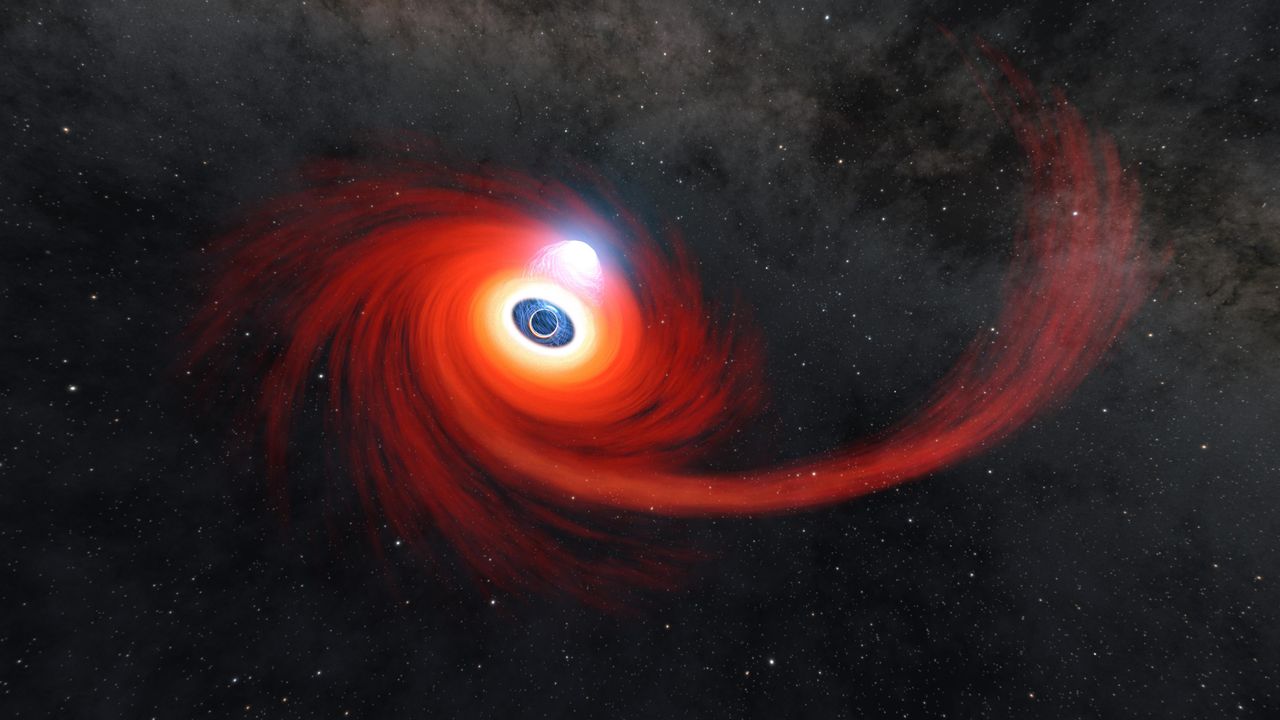
The James Webb Space Telescope (JWST) has identified the most distant known 'black hole star,' designated MoM-BH*-1, which could elucidate the nature of the mysterious little red dots (LRDs) detected shortly after the Big Bang. This discovery, reported by Space.com, positions MoM-BH*-1 as a critical link in understanding these enigmatic cosmic features.
MoM-BH*-1 was discovered through the JWST's Mirage or Miracle (MoM) survey and is located at a redshift of 7.7569, corresponding to approximately 660 million years after the Big Bang. This places it at a light-travel distance of about 13.14 billion light-years from Earth. The black hole star is spatially near a young galaxy at the same redshift, with models suggesting a potential merger in about 100 million years.
Photometric measurements reveal that MoM-BH*-1 has a break strength of 7.7 with flux densities of 140 nJy at 4050 Å and 18 nJy at 3670 Å. Its physical size is constrained to less than 117 parsecs, and its ultraviolet absolute magnitude is approximately –18.1. The host galaxy's mass is estimated to be less than 10^8.5–10^8.8 solar masses.
This finding supports the hypothesis that LRDs may include early-stage black hole stars, where the black hole's influence is predominant. The discovery of MoM-BH*-1, alongside other observations such as GLIMPSE-17775 and Abell 2744-QSO1, suggests a continuum of black hole growth in the early universe, from isolated nascent black holes to more enshrouded, accreting entities merging into young galaxies.