Astronomers Capture Rare Evolutionary Stage of Millisecond Pulsar and White Dwarf
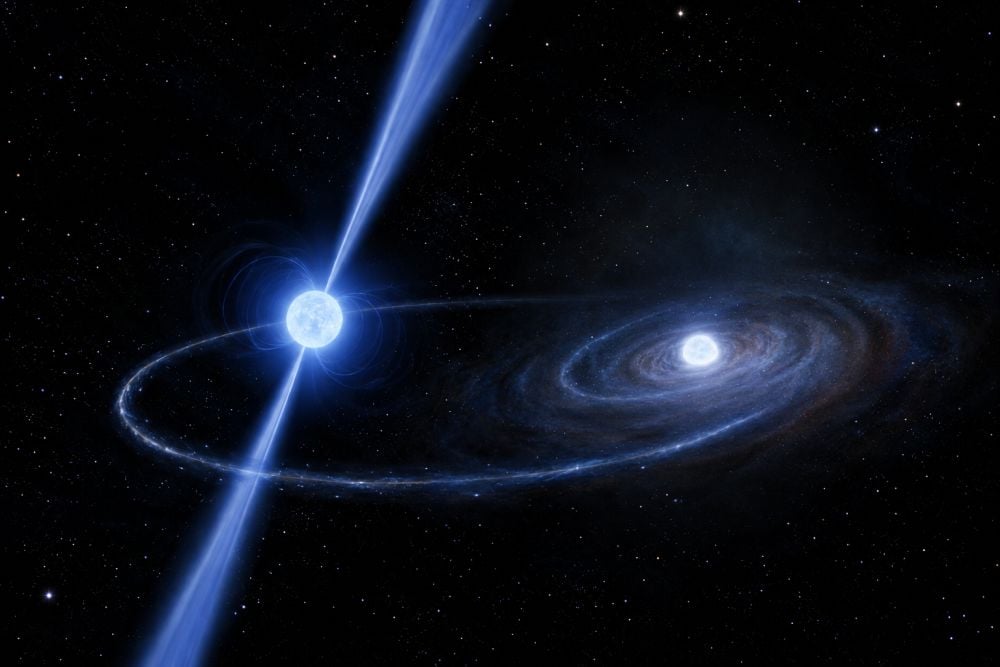
Astronomers have observed a millisecond pulsar (MSP) in the globular cluster NGC 362, designated NGC 362D, with a helium white dwarf companion in a rare post-mass transfer phase. This discovery provides a unique opportunity to study the early stages of white dwarf cooling and the effects of mass transfer in binary star systems.
The white dwarf companion has a mass of approximately 0.18 solar masses (M☉) and is still in its pre-cooling phase, according to a study accepted in Astronomy & Astrophysics Letters. The mass transfer phase is estimated to have ended around 0.6 billion years ago, making this system the youngest-known white dwarf companion to a millisecond pulsar.
Observations from the Hubble Space Telescope revealed wavelength-dependent brightness variations, attributed to residual circumstellar material. This debris is evidence of the recent mass transfer that accelerated the companion's evolution into a white dwarf.
This system offers a rare glimpse into the immediate aftermath of stellar recycling, where a white dwarf orbits a millisecond pulsar, allowing direct study of this transitional evolutionary stage.