Anomalous Particle Interaction Sparks Dark Matter Interest
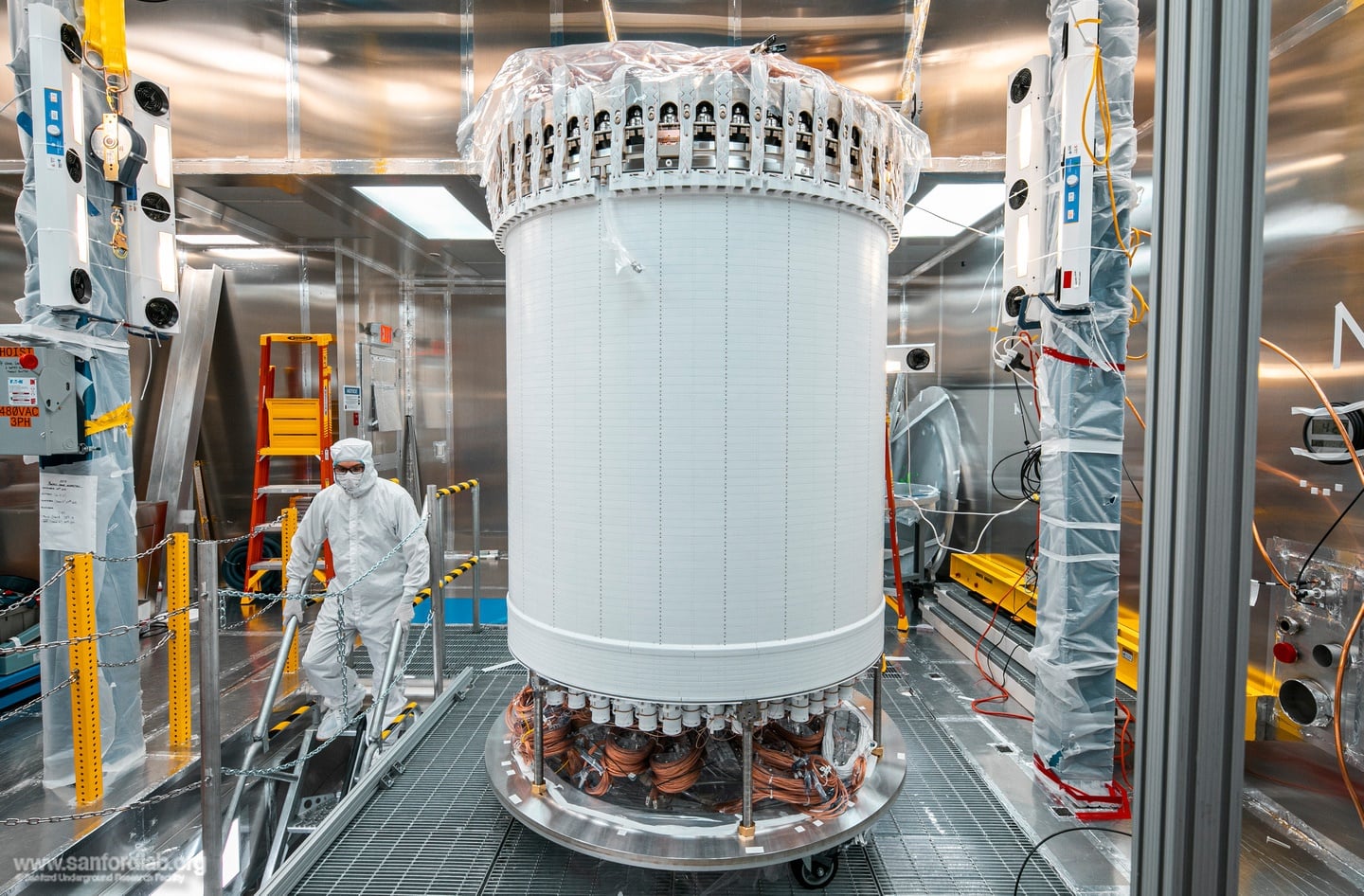
The LUX-ZEPLIN (LZ) experiment, conducted at the Sanford Underground Research Facility in South Dakota, has recorded a single particle interaction that could potentially be a sign of dark matter. This finding comes from an analysis of 220 live days of data collected between March 2023 and April 2024.
The interaction, if caused by a dark matter particle, specifically a Weakly Interacting Massive Particle (WIMP), would suggest a mass at least 200 times that of a proton. However, the statistical significance of the event is 2.6 sigma, indicating a 0.5% chance that it could be a result of known background processes, far from the 5-sigma threshold required for a discovery in particle physics.
The LZ project, managed by the U.S. Department of Energy’s Lawrence Berkeley National Laboratory, involves around 250 scientists and engineers from 39 institutions. The experiment is conducted nearly a mile underground, using a tank with approximately 10 tonnes of ultra-pure liquid xenon to detect potential WIMP collisions.
Rick Gaitskell, LZ spokesperson from Brown University, emphasized caution, stating, “With only one event, we don’t want to get ahead of ourselves. We are not claiming to have seen dark matter.” The unexpected nature of the result, noted by Imperial College London, arises because researchers anticipated any potential WIMP signal to appear at a lower energy.
The findings were presented at the 2026 TeV Particle Astrophysics conference in Japan, and a paper is expected to be submitted to Physical Review Letters after being posted on arXiv.